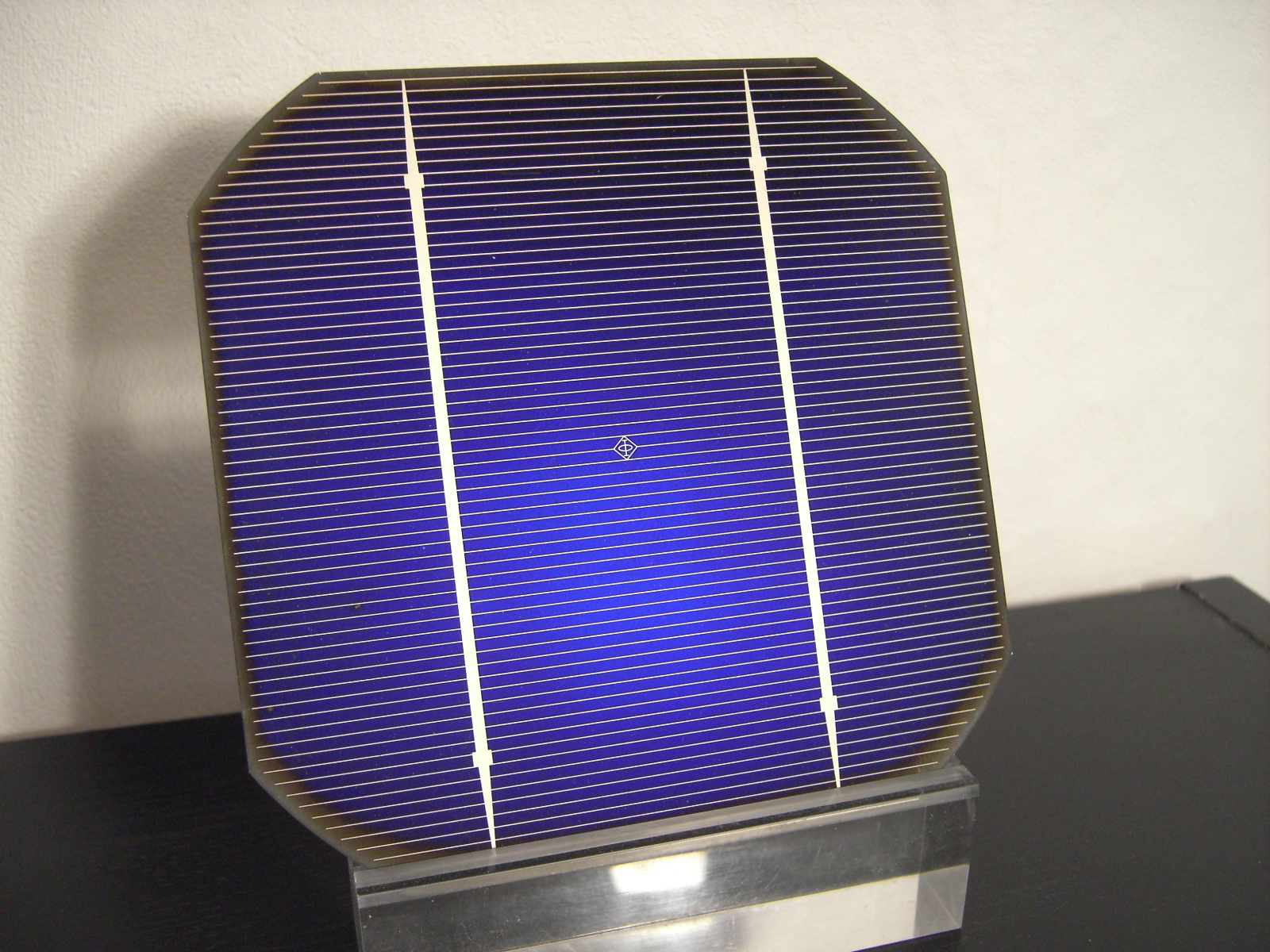
Monocrystalline Silicon Panels
Monocrystalline panels are manufactured from a single continuous silicon crystal grown using the Czochralski process. The resulting cells have a uniform dark appearance and the highest conversion efficiency of the three main technologies.
Current commercial monocrystalline modules — including PERC (Passivated Emitter and Rear Cell) and newer TOPCon (Tunnel Oxide Passivated Contact) variants — typically achieve module efficiencies in the range of 20 to 23 percent under standard test conditions. High-efficiency half-cut cell designs from manufacturers such as LONGi, Jinko Solar, and Trina have pushed commercially available panels above this range in recent years.
Temperature Behaviour
Photovoltaic panels produce less power as temperature rises. Monocrystalline panels have a temperature coefficient of power (Pmax) of approximately −0.30 to −0.40% per degree Celsius above 25°C. In Poland's temperate climate, summer rooftop temperatures can exceed 60°C on south-facing surfaces. A panel rated at 400 Wp at 25°C might deliver around 360 Wp on a hot July afternoon.
Physical Characteristics
Standard residential monocrystalline modules measure approximately 1700×1100 mm for a 400–415 Wp panel and weigh between 19 and 22 kg. The cells have characteristic chamfered corners — a consequence of cutting wafers from a round crystal boule — though full-square cells (sometimes called M10 or G12 wafers) produced from larger ingots have reduced or eliminated this feature in newer product lines.
Monocrystalline panels are the dominant choice for residential installations in Poland where roof area is limited, because their higher efficiency allows more power output from a given roof space.
Polycrystalline Silicon Panels
Polycrystalline (also called multicrystalline) panels are cast from molten silicon poured into square moulds and allowed to cool. The process produces multiple crystal structures within each cell, visible as a speckled, blue metallic appearance. The manufacturing process is less energy-intensive than monocrystalline, which historically made these panels less expensive per unit.
Efficiency and Market Position
Polycrystalline module efficiency ranges from approximately 16 to 18 percent. As monocrystalline production costs have declined significantly, the price gap between the two technologies has narrowed. For new residential installations in Poland as of 2025–2026, monocrystalline panels dominate the market for standard rooftop systems, while polycrystalline products have largely migrated to utility-scale and cost-sensitive applications.
Temperature Coefficient
Polycrystalline panels have a slightly worse temperature coefficient than monocrystalline, typically in the −0.40 to −0.45% per °C range, meaning they lose a slightly higher percentage of rated output under high heat conditions.
Thin-Film Technologies
Thin-film panels deposit semiconductor materials in layers only a few micrometres thick onto a glass, plastic, or metal substrate. The main commercial thin-film technologies are cadmium telluride (CdTe), amorphous silicon (a-Si), and copper indium gallium selenide (CIGS).
CdTe
First Solar's CdTe modules are the most widely deployed thin-film technology globally, primarily in large ground-mounted installations. Module efficiency is typically 17–19%. CdTe panels are not commonly specified for small residential rooftop systems in Poland.
CIGS
CIGS panels achieve efficiencies of 14–17% at the module level and are available in flexible formats suitable for curved surfaces or standing seam metal roofs. Some manufacturers offer building-integrated photovoltaic (BIPV) products based on CIGS.
Temperature Performance Advantage
Thin-film technologies generally have lower temperature coefficients than crystalline silicon — amorphous silicon, for instance, has a near-zero or slightly positive temperature response, meaning it handles high operating temperatures better in relative terms. This can be relevant for rooftops with poor ventilation behind the panel.
Comparison Summary
| Technology | Typical Module Efficiency | Temp. Coefficient (Pmax) | Typical Use Case |
|---|---|---|---|
| Monocrystalline (PERC/TOPCon) | 20–23% | −0.30 to −0.40% / °C | Residential, limited roof area |
| Polycrystalline | 16–18% | −0.40 to −0.45% / °C | Budget-focused, larger roofs |
| CdTe thin-film | 17–19% | −0.25 to −0.30% / °C | Utility-scale |
| CIGS thin-film | 14–17% | −0.25 to −0.35% / °C | BIPV, flexible substrates |
Panel Selection for Polish Residential Rooftops
For a typical residential installation in Poland — a pitched roof with 20–40 m² of usable south-facing surface — the choice falls almost exclusively between monocrystalline products. The key practical variables are:
- Available roof area: A smaller usable area favours higher-efficiency panels to maximise total system output.
- Shading conditions: Rooftops with partial shading from chimneys, dormers, or nearby trees benefit from module-level optimisation (microinverters or DC optimisers) regardless of panel technology.
- Roof orientation: South-facing (azimuth 180°) at 30–40° pitch is optimal. East-west split installations are common in Poland to reduce peak production and spread generation across more hours.
- Product warranties: Established manufacturers offer 25-year linear power output warranties, typically guaranteeing at least 80–87% of rated output at the end of the warranty period. The manufacturer's continued existence is relevant to warranty claims — a consideration when selecting between tier-1 and lesser-known brands.

What Panel Datasheets Do Not Show
Standard test conditions (STC) — 1000 W/m² irradiance, 25°C cell temperature, AM1.5 spectrum — rarely reflect real-world operating conditions. The nominal operating cell temperature (NOCT) rating (typically measured at 800 W/m² irradiance, 20°C ambient, 1 m/s wind) gives a closer approximation of typical behaviour but still does not capture the full range of conditions a panel will face across Polish seasons.
Energy yield simulation tools such as PVsyst or the PVGIS web tool maintained by the European Commission's Joint Research Centre (PVGIS) account for temperature losses, irradiance distribution, and other factors to produce annual energy output estimates specific to a location and system configuration.